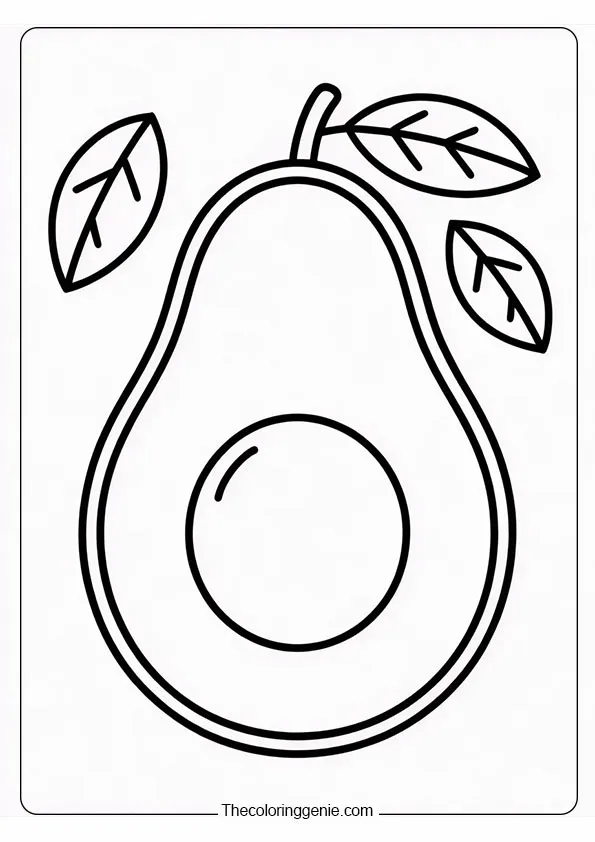
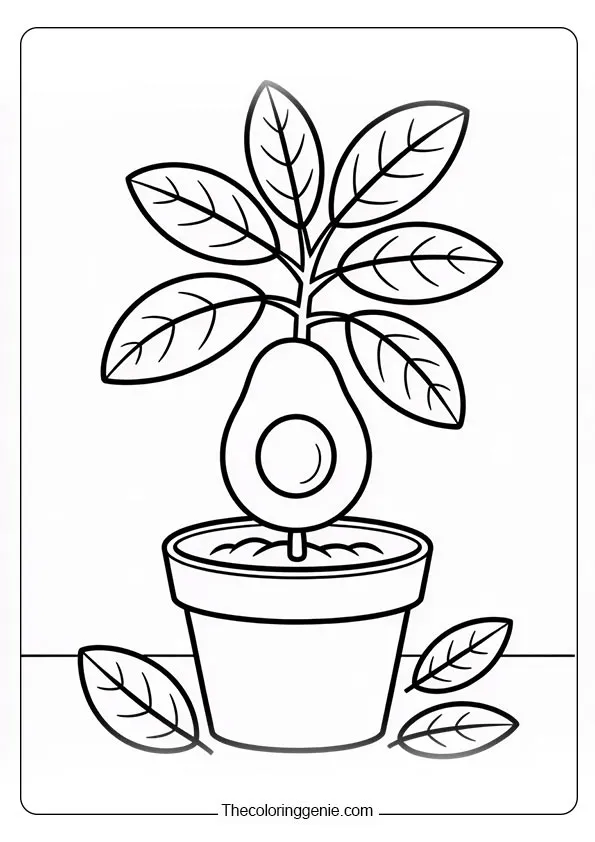
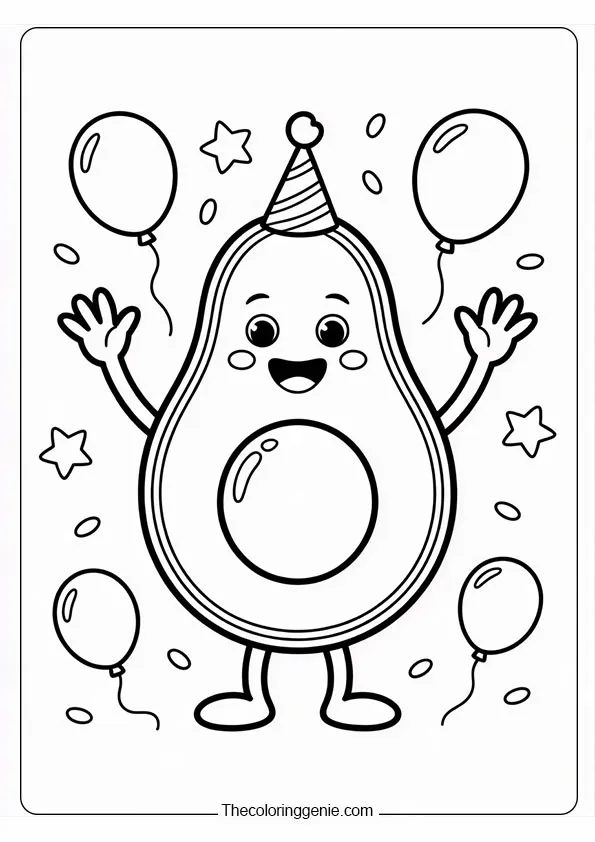
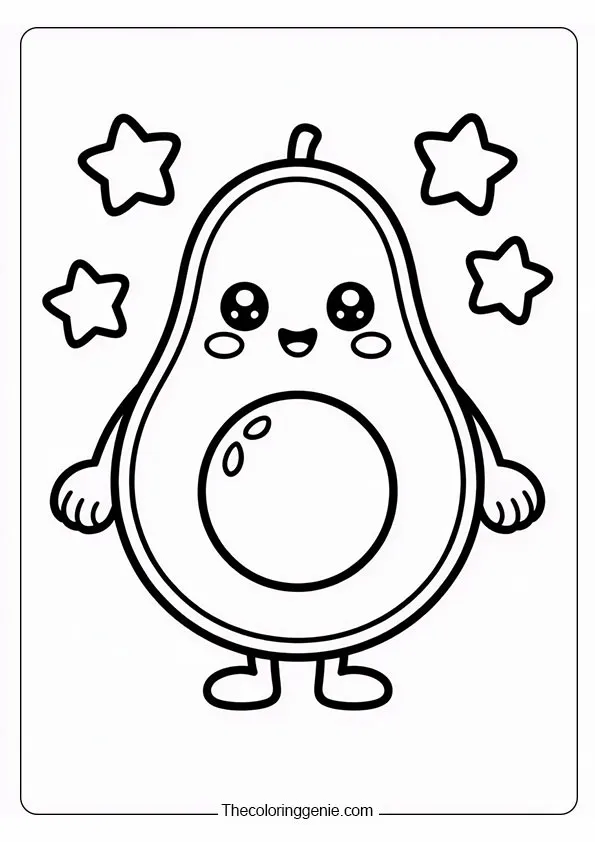
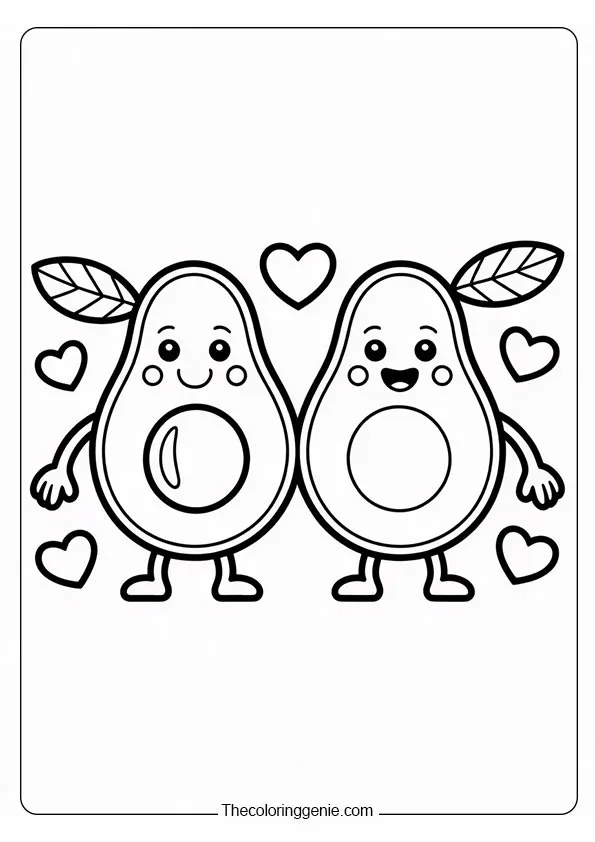
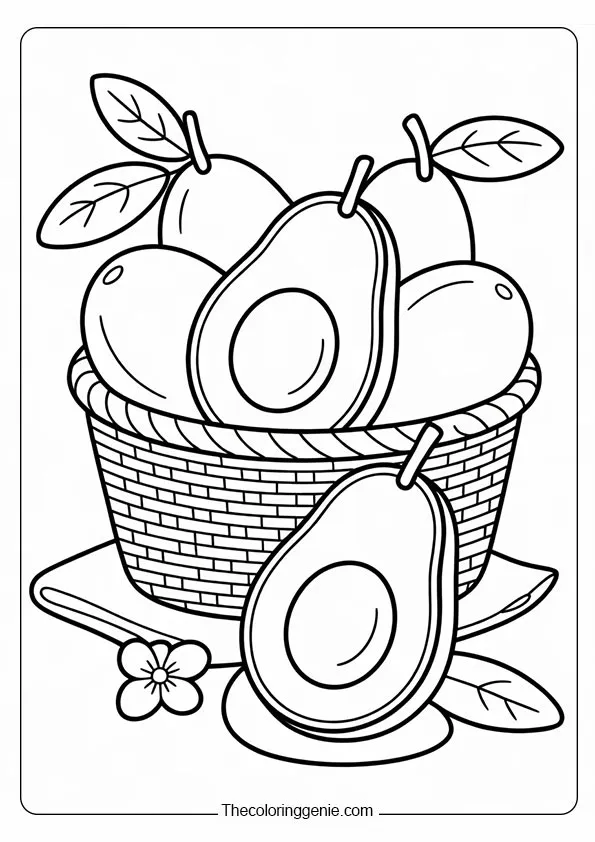
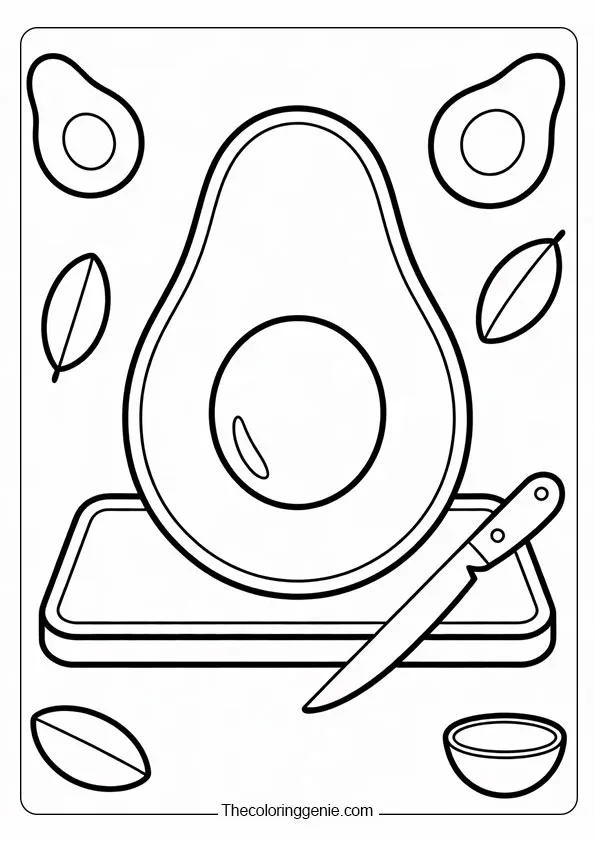
Half an avocado is one of the easiest shapes to color well: a curved skin, a soft green middle, and one big round pit. These pages run from {a single avocado half with thick outlines} for toddlers to {cute kawaii avocados with faces} and {finer-lined designs} for older kids and adults. Each is a high-resolution PDF for US Letter or A4 with no account needed, and every one can also be colored online.
Avocados hide a few surprises, too. Botanically, they’re berries; they don’t ripen while they’re still on the tree, and half of one has more potassium than a medium banana. Those facts, plus a guide to coloring the skin, flesh, and pit, are below the gallery.
Free Printable Avocado Coloring Pages for Kids
Choose by detail level rather than exact age: thick outlines and large spaces for ages 2–4, cute avocados with faces and simple scenes for ages 5–8, and smaller patterns for older kids and adults.
An avocado is three color jobs in one. Plan each part before you start.
Part
Real color
How to color it
Skin (Hass)
Green when unripe, purplish-black when ripe
Choose one look. Add tiny darker dots for the bumpy texture
Skin (smooth types)
Green or shiny yellow-green
Leave a thin white streak along one side for shine
Flesh
Dark green just under the skin, fading to pale yellow near the pit
Use three bands (dark green, bright green, pale yellow) and blend where they meet
Pit
Warm brown
Brown base, then a lighter patch on one side so it looks round and glossy
Ripe or Unripe? Pick Your Skin Color
Bright green skin gives a fresh, cartoon look. Purplish-black looks like a ripe Hass, the dark, bumpy avocado most stores sell. On a ripe avocado, a dark purple base with a few black dots on top looks more real than flat black.
Giving a Kawaii Avocado Its Face
Cute avocados are all about the face. These steps keep it clean.
Finish the greens first, so the face sits on top of the color instead of getting smudged.
Color the eyes solid black or dark brown, leaving a small white dot in each one for sparkle.
Add blush as small pink ovals under the eyes, pressing lightly so the green still shows through.
If the pit is drawn as a round belly, color it warm brown with a lighter circle on one side.
Trace over any lines you covered with a fine black pen so the face stays crisp.
Avocado Facts Worth Knowing
It’s a berry. Botanically, an avocado is a fruit, specifically a large berry with a single seed in the middle.
It comes from Mexico or Central America, where avocados are believed to have originated. Mexico still grows more than any other country.
It beats a banana on potassium. According toHarvard’s Nutrition Source, half a medium avocado has about 487 mg of potassium, compared with about 422 mg in a medium banana. Harvard notes that potassium helps regulate blood pressure and heart rhythm.
It’s a good source of fiber, and most of its fat is the monounsaturated kind.
It doesn’t ripen on the tree. Avocados normally soften only after they’re picked, which is why many store avocados are still firm and green.
Every Hass tree has one ancestor. Every Hass avocado tree grown for fruit traces back, through grafting, to a single tree that California mail carrier Rudolph Hass planted in the 1920s.
Things to Do With Finished Avocado Pages
Classroom Idea: From Tree to Table
A ripeness chart that makes the “doesn’t ripen on the tree” fact easy to see.
Print the same whole-avocado page three times for each student or group.
Color the first bright green and label it “just picked.”
Color the second dark green (“ripening”) and the third purplish-black (“ready to eat”).
Glue all three in order on a strip of paper, with an arrow labeled “after picking.”
Add one fact from the list above underneath.
It fits a plant, food, or healthy-eating unit. If you bring in a real avocado to compare, check for food allergies first.
Home Craft: Avocado Bookmark
Color a small avocado half design.
Cut it out and glue it to the top of a strip of heavier paper about 2 inches wide.
Punch a hole at the top and tie a short ribbon through it.
Write the reader’s name on the back.
Safety tip: An adult should handle the scissors and the hole punch with young children. Keep ribbon and paper scraps away from babies and toddlers.
FAQ’s
What color is an avocado’s skin?
It depends on the variety. The California Avocado Commission says a Hass avocado turns dark green or black as it ripens, while some other varieties stay light green even when ripe.
What colors should I use for the inside of an avocado?
A common way is a light yellow-green in the middle, with a deeper green toward the skin. It’s your choice, and any green works.
What color is the pit?
Brown is the usual choice. Leave a small pale patch where the light hits, and it will look round.
Is an avocado a fruit?
Yes. Britannica describes the avocado as the edible fruit of a tree in the Lauraceae family, with a large seed inside.
Where did avocados first come from?
Britannica says the plants were domesticated in tropical America before the Spanish conquest.
Which avocado page should I print first for a toddler?
Pick one from the preschool group. Those have the biggest spaces and thickest outlines so that a toddler can finish one quickly.
No comments to show.
Sarah Mitchell
Illustrator & Creative Artist at The Coloring Genie
Sarah Mitchell creates printable coloring artwork for The Coloring Genie,
including animal, nature, seasonal and imaginative designs. She focuses
on creating clear outlines and printable designs that are enjoyable to
color. Explore Sarah’s published work or see how she develops a coloring
page from an early sketch to the finished artwork.