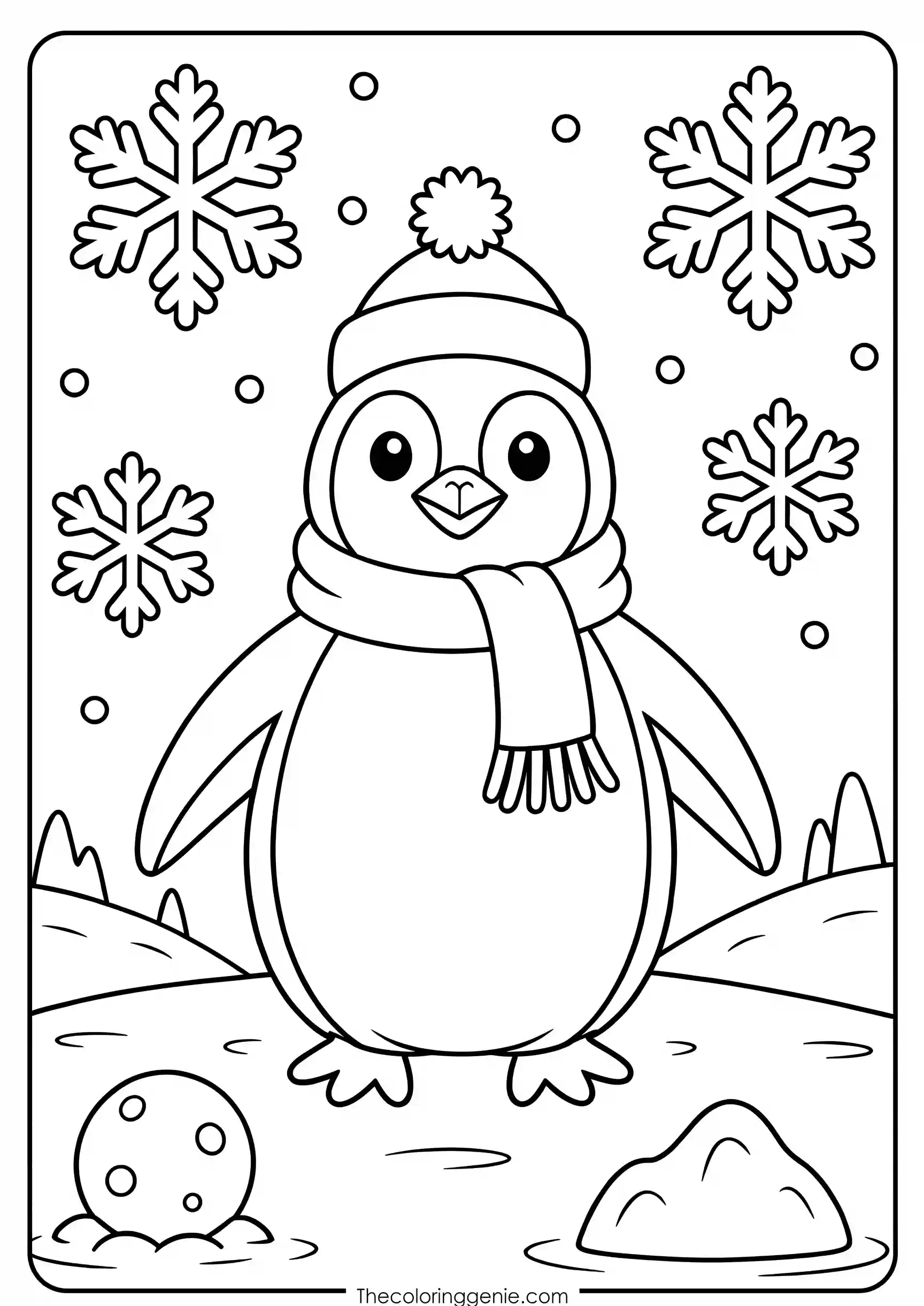
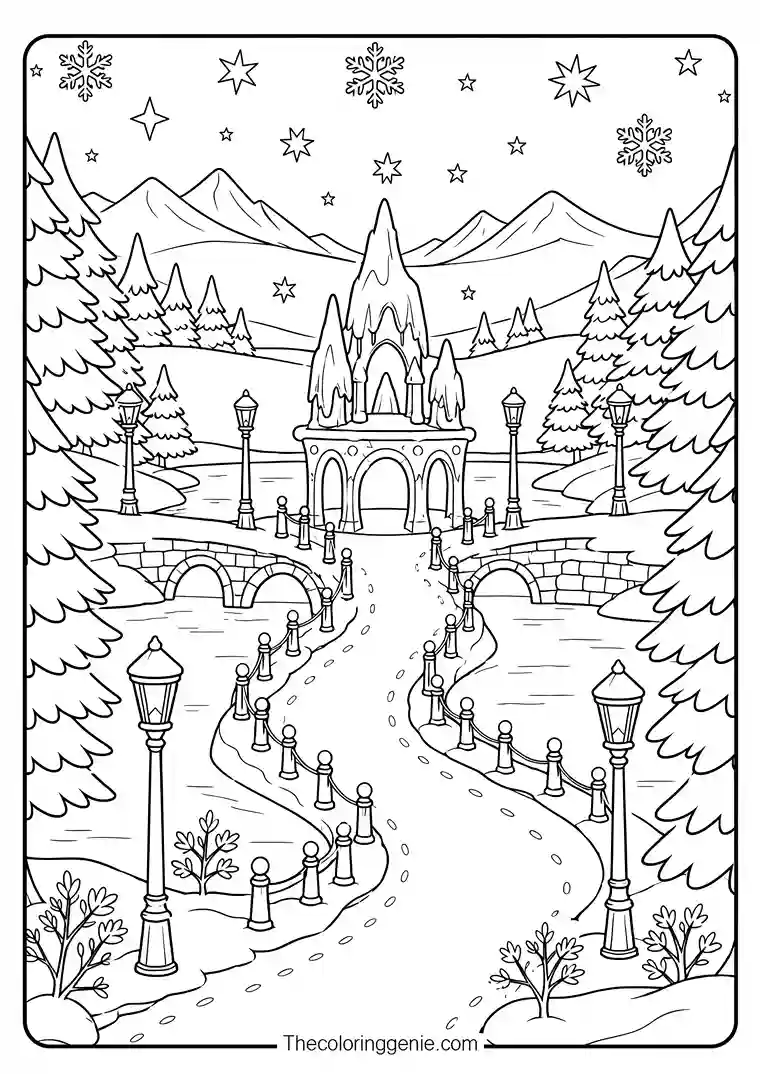
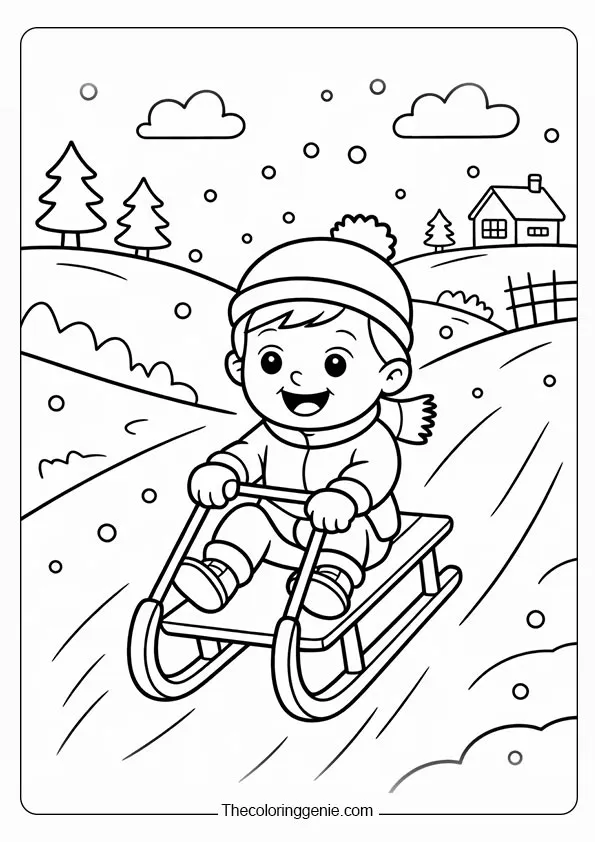
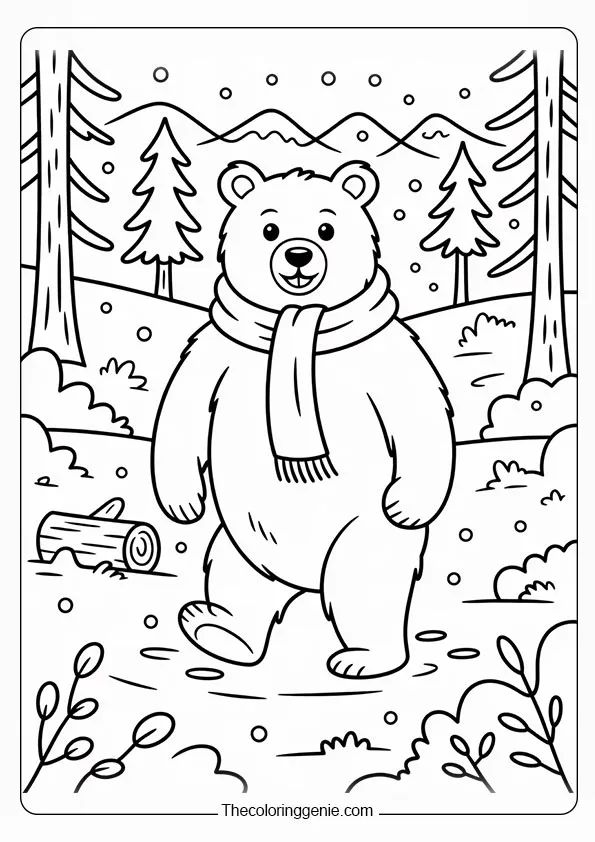
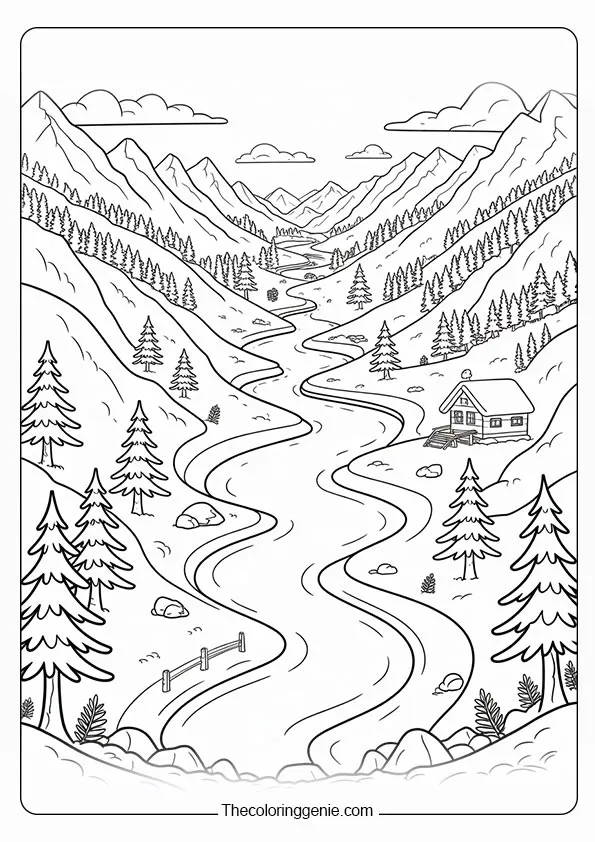
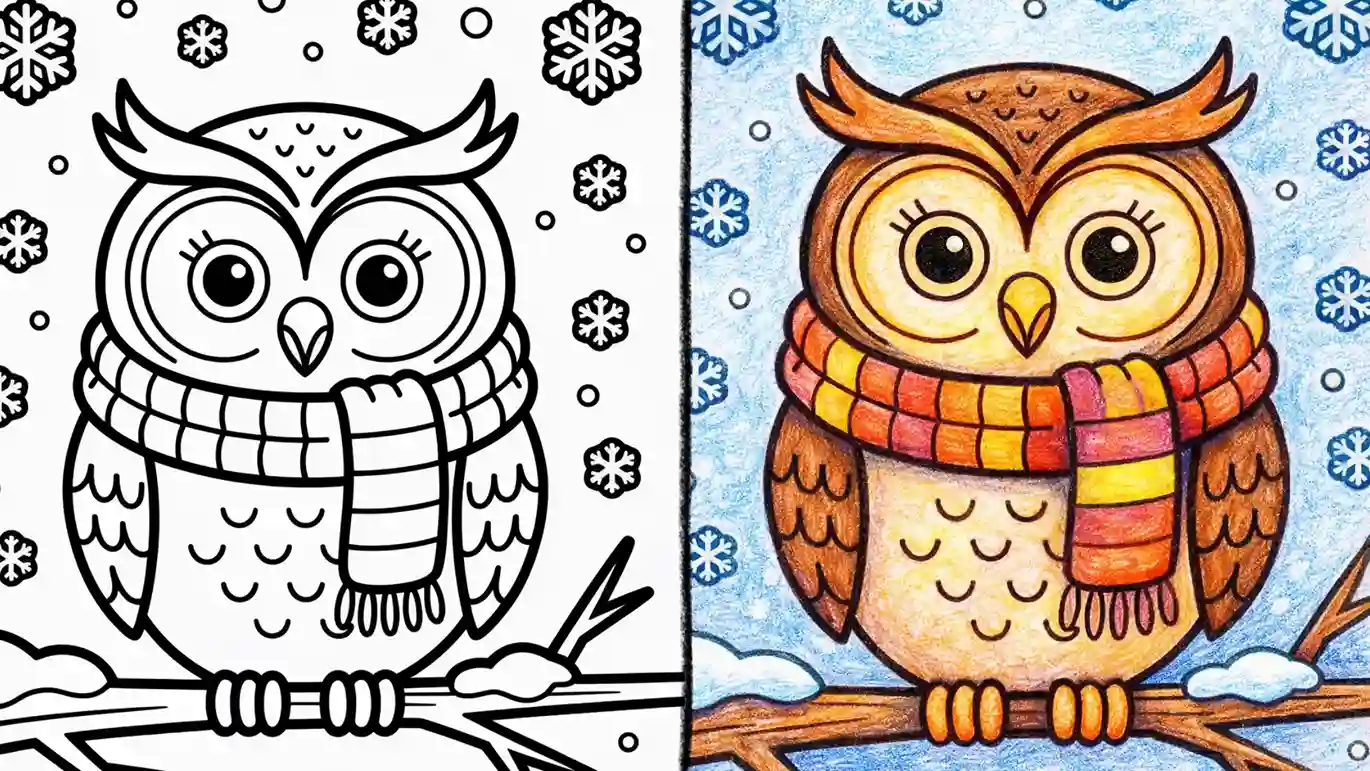
These winter coloring pages are sorted by age, from {a single snowman with a big round body} for preschoolers to a detailed winter wonderland scene for older kids and adults. Each one is a high-resolution PDF for US Letter or A4, with no account needed, and every design can also be colored online.
Winter is where color choices matter most, because the main subject, snow, isn’t really white. Below the gallery you’ll find the reason snow often looks blue, a short guide to coloring it so it doesn’t look flat, and how winter animals change color for the season.
Free Printable Winter Coloring Pages for Kids
Choose by detail level: thick outlines and large shapes for ages 2–4, snowy scenes, animals, and cozy cabins for ages 5–8, and fine detail for older kids and adults. Start with the group that fits, and move up when the simpler pages start to feel too quick.
Clean snow reflects most visible sunlight, which is why it looks white. But deep snow can look blue.According to the National Snow and Ice Data Center, light that travels into snow gets scattered by the ice grains, and the snow absorbs more red light than blue. In a layer about a meter thick, mostly blue light makes it through.
That’s why a footprint, a drift, or the shadowed side of a hill often looks pale blue. So when you color snow, use white for the lit surface and a soft blue for the deeper or shadowed parts.
How to Color Snow So It Doesn’t Look Flat
Try this on a snowman, a hill, or a rooftop.
Leave the paper white on every surface the light hits, usually the top and one side.
Choose one pale blue and shade it lightly along the opposite side, under the snowman’s head, and where the ball meets the ground.
Add a little lavender or gray-blue at the darkest edges, pressing slightly harder.
Color one warm accent, such as a red scarf, an orange carrot nose, or a yellow cabin window, so the cool blues have something to contrast with.
Color the sky last so it doesn’t smudge into the snow. Pale blue-gray reads as daytime, and deep navy as evening.
On a snowflake page, snow can fall as symmetrical, six-sided flakes, so repeat the same colors on all six arms.
Coloring Winter Animals
Some animals change color with the seasons.According to the National Park Service, snowshoe hares go from brown in summer to almost pure white in winter, and the change is triggered by the shorter days.
When you color a white winter animal on a snowy page, leave the body white or very pale, and make the background around it a soft blue-gray or a gentle sky color. A dark nose and eye finish the look. A cardinal is the opposite case: its red feathers are one of the few strong colors in a snowy scene.
Tools for Winter Pages
Snow and sky: pale blue and lavender pencils, used lightly.
Big sky areas: a crayon on its side, or washable markers on heavier paper.
Snowflakes on a dark sky: a white gel pen or white crayon.
Falling snow: a cotton swab dipped in white paint, dabbed over a dry page.
Warm accents: markers for bold scarves and mittens.
Things to Do With Finished Winter Pages
Classroom Idea: Winter Coat Match
A short science activity based on the snowshoe hare’s seasonal color change.
Print the same animal page twice for each student.
Color the first as the animal looks in summer, in brown.
Color the second as it looks in winter, in white with a soft blue background.
Label them “summer” and “winter.”
On the back of the winter page, write one sentence about why a white coat helps in snow.
It fits a unit on seasons, animal adaptations, or camouflage.
Home Craft: Frosted Window Scene
Color a small winter scene, such as a cabin or a snowman.
Cut it out and tape it to a window with the picture facing in.
Glue a few cotton balls along the bottom as snowdrifts.
Hang a strip of white paper above it as a snowfall edge.
Safety tip: An adult should handle the scissors and glue with young children. Keep cotton balls and small paper scraps away from babies and toddlers.
FAQ’s
When does winter start?
The Old Farmer’s Almanac lists the December 2026 winter solstice, the first day of winter in the Northern Hemisphere, as Monday, December 21, 2026, at 3:50 PM EST. It’s the day with the least daylight of the year.
How many sides does a snowflake have?
Six. NOAA says snowflakes have six-fold radial symmetry, because ice has a six-sided crystal structure.
Are all snowflakes different?
NOAA says “no two snowflakes are the same” may be true, since the chance of two flakes forming under identical microscopic conditions is “astronomically unlikely.”
How do snowflakes form?
According to NOAA, water vapor solidifies on a tiny particle and grows into an ice crystal. It grows either as flat facets or as branches, and can switch between the two.
What colors should I use for a snowy scene?
Leave the snow as white paper and color the sky, trees, and clothing around it. Pale blue and gray shading under snowdrifts makes them look round.
Which tools suit winter pages best?
Colored pencils for fine lines like snowflakes, and washable markers for scarves and mittens on heavier paper.
No comments to show.
Sarah Mitchell
Illustrator & Creative Artist at The Coloring Genie
Sarah Mitchell creates printable coloring artwork for The Coloring Genie,
including animal, nature, seasonal and imaginative designs. She focuses
on creating clear outlines and printable designs that are enjoyable to
color. Explore Sarah’s published work or see how she develops a coloring
page from an early sketch to the finished artwork.