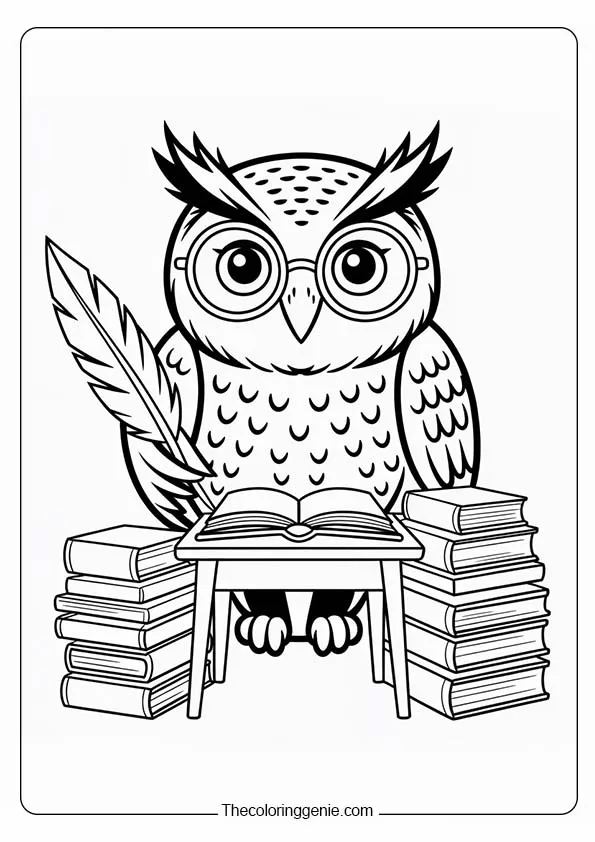
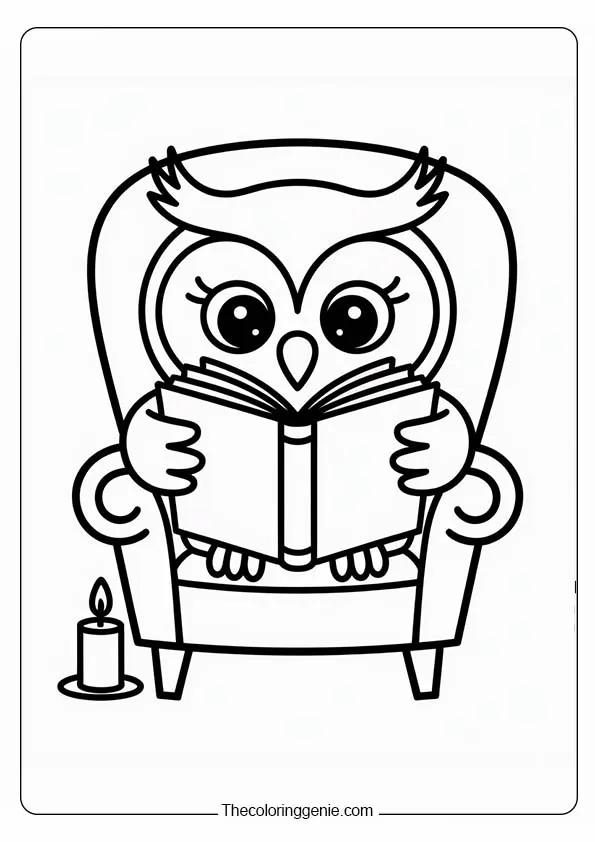
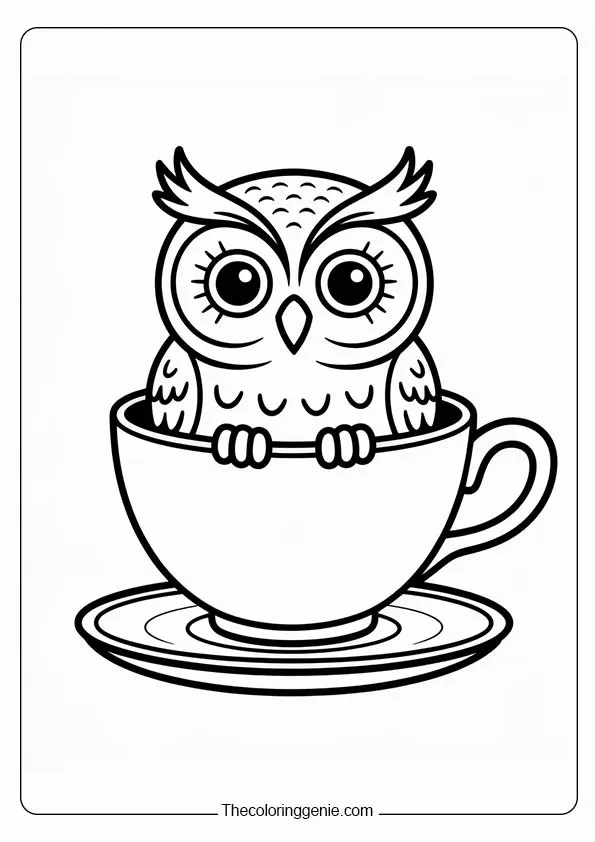
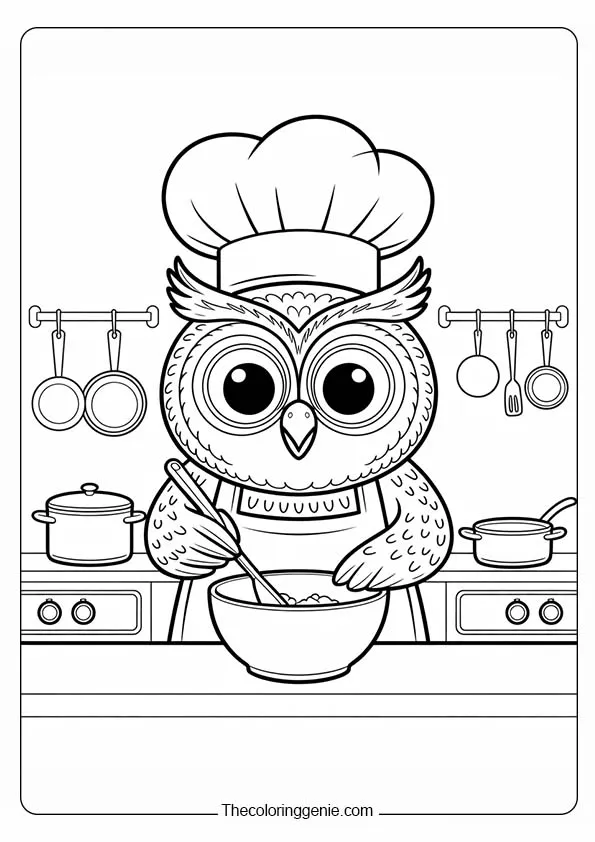
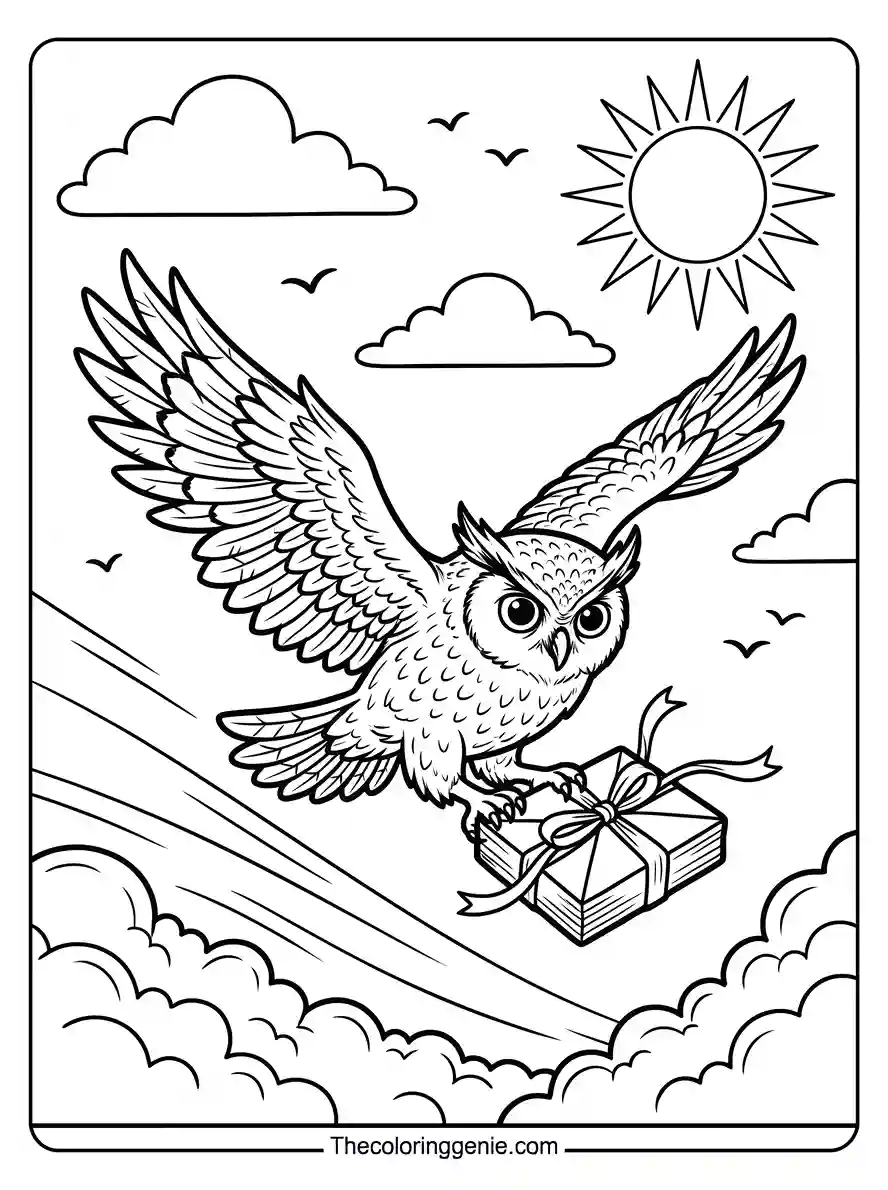
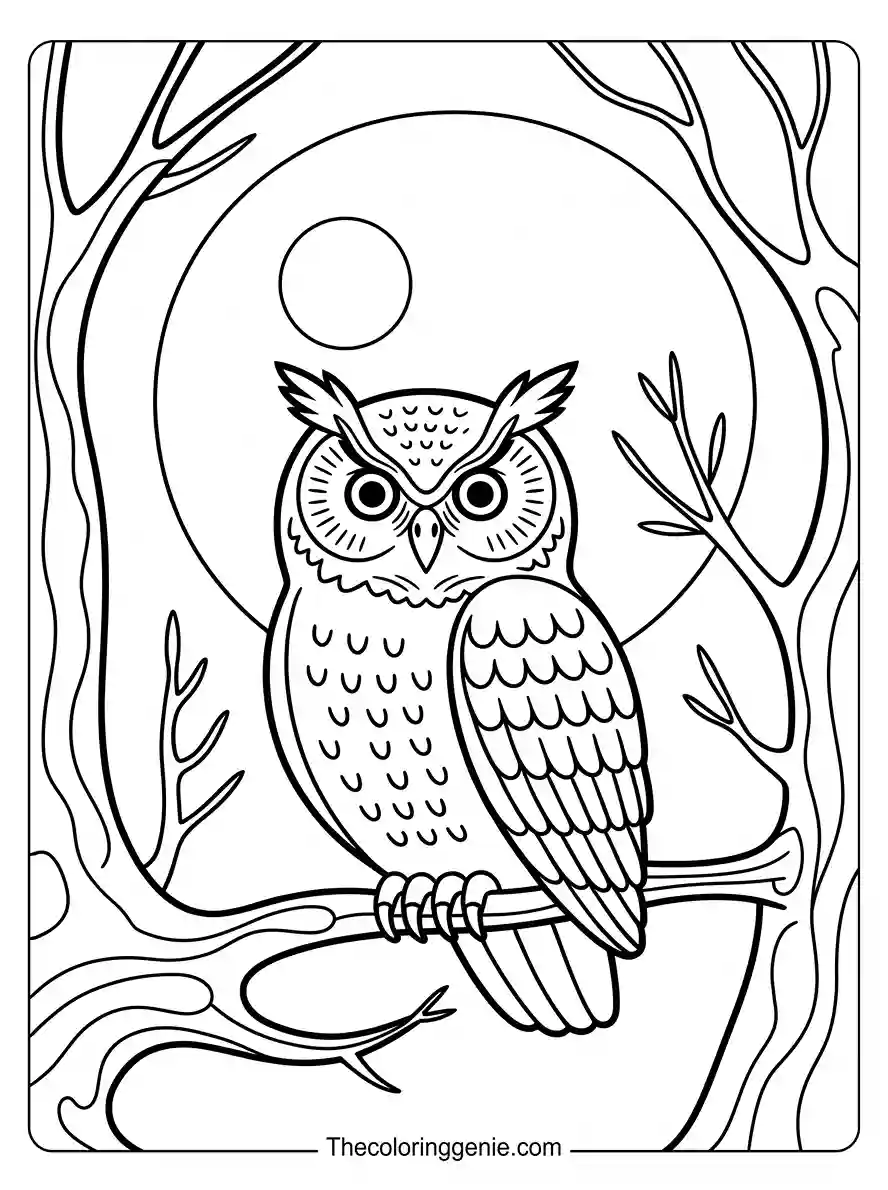
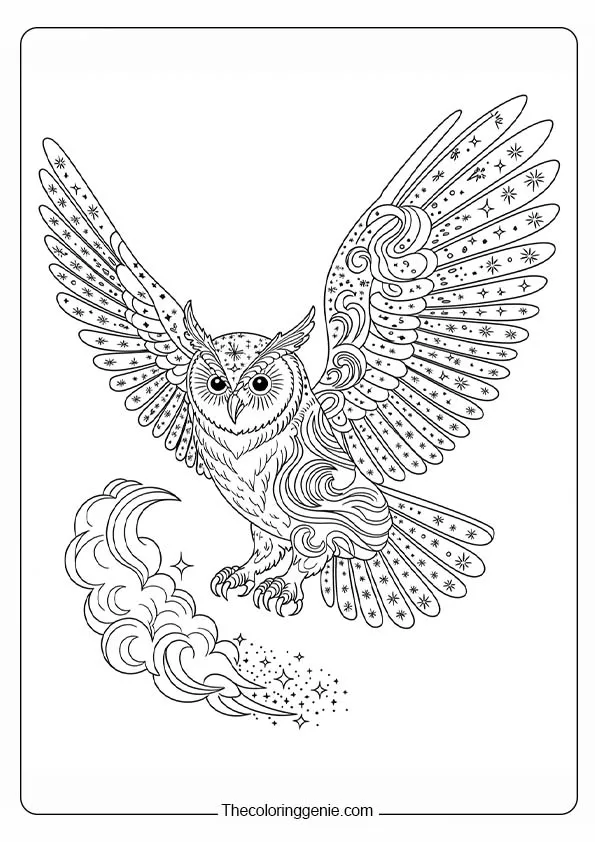
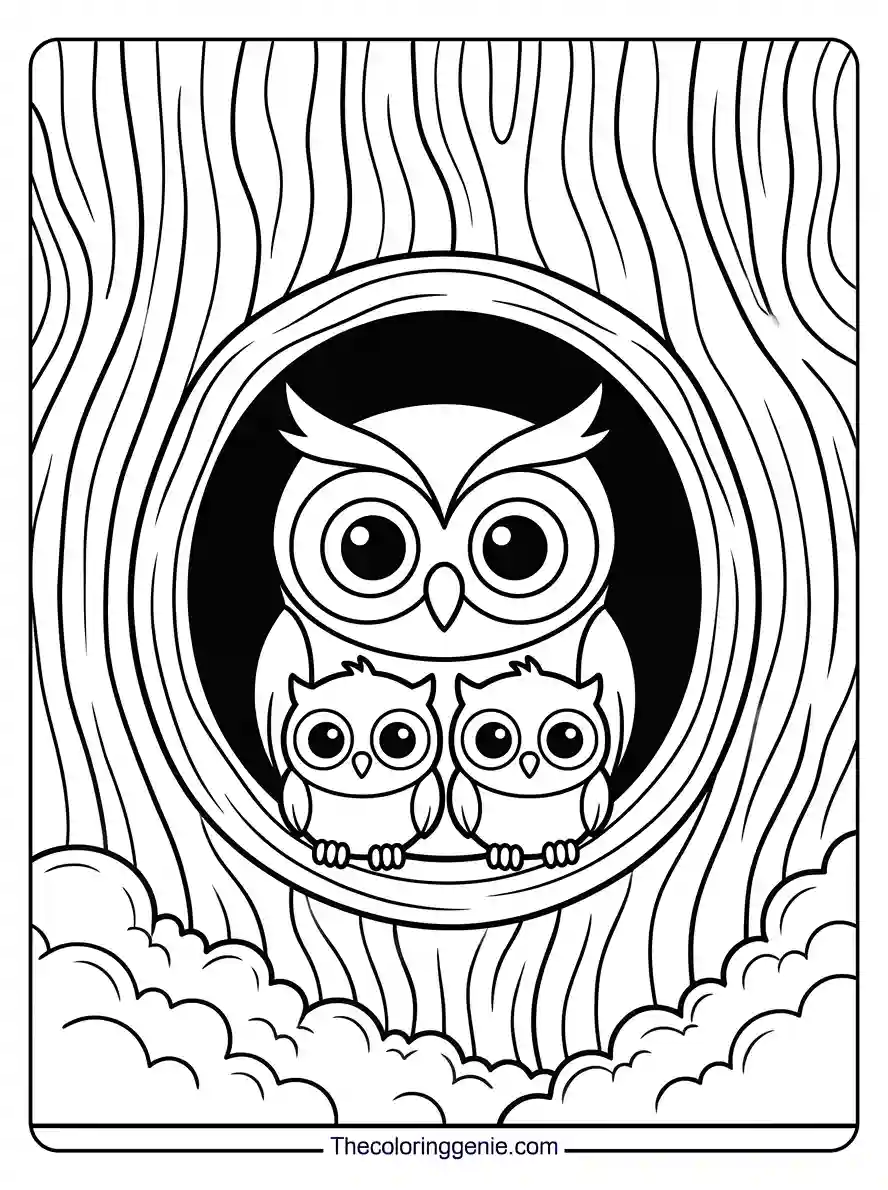
Free owl coloring pages to print: round cartoon owls, baby owls on branches, real species like the barn owl, snowy owl, and great horned owl, and detailed feather designs for older kids and adults. Every design is grouped by age and downloads as a high-resolution PDF for US Letter or A4. No account is needed, and you can color online too.
Owls are interesting to color because of their large eyes, distinctive faces, and layered feathers. Below the gallery you’ll find how to color owl eyes and feathers, what real owls look like, a fact about why owls turn their heads so far, and classroom and family ideas for nocturnal-animal lessons and quiet evenings.
Free Printable Owl Coloring Pages for Kids and Adults
Every page is free to print and grouped by age: big, simple owls for the youngest, real species and woodland scenes for school-age kids, and finer feather detail for older kids and adults.
Regular printer paper usually works well with crayons and colored pencils. If you’re using markers, choose slightly heavier paper and put a protective sheet underneath, as some inks may bleed through.
Why Owls Turn Their Heads So Far
An owl can’t move its eyes, so it moves its head. According to theNational Park Service, owls have large, fixed eyes at the front of the head, and because “their eyes can’t move,” they must turn their heads to see something to the side. They have 14 neck vertebrae and can turn their heads up to 270 degrees in either direction, which lets them see more than a full circle.
The park service adds that owls fly silently when hunting, thanks to wide wings with soft, comb-like edges on the flight feathers, and that their eyes are about 100 times more sensitive to light than human eyes. They can see during the day, but hunt at night when their prey is out.
What Colors Are Real Owls?
Real owls come in different colors and patterns depending on the species. If you want your owl to look natural, try these:
Owl
Colors to use
Barn owl
White heart-shaped face with dark eyes; a mix of buff and gray on the head, back, and wings; white below
Snowy owl
White, with dark barring that varies: males are paler and whiter with age, while females show denser “salt-and-pepper” markings; yellow eyes
Great horned owl
Brown and gray tones, a white throat, horizontal bars on the belly, long ear-like tufts, and yellow eyes
You don’t have to follow natural colors, though. Cartoon owls look just as playful with purple wings, turquoise feathers, or bright pink faces.
How to Color Owl Eyes and Feathers
An owl’s eyes are often the most noticeable part of the drawing, so start there.
Start with the eyes. Choose yellow, orange, brown, or an imaginative color for the iris.
Leave a small highlight. Keep a tiny white spot in each eye to suggest reflected light.
Color the facial feathers. Use lighter tones around the eyes and slightly darker shades near the edges.
Follow the feather shapes. Make short pencil strokes in the direction of the feathers instead of long, random lines.
Add gentle shading. Layer a darker color along the edges of the wings or beneath overlapping feathers to create depth.
For simple cartoon owls, flat, bright colors work well too.
Best Coloring Tools for Different Designs
Crayons: simple outlines and large open spaces. Chunkier crayons are easier for younger children.
Washable markers: bold colors on cartoon owls and medium-detail scenes. Use heavier paper.
Colored pencils: fine feather patterns, borders, and gradual shading on detailed designs.
A sharpened pencil or gel pen: small eyes, tiny feathers, and leaves.
Owl Activities for School and the Classroom
Owl Expert Wall
Give students different owl pages to print and color.
Ask each to choose a real species to research, such as a barn owl, snowy owl, or great horned owl.
Have them write two or three facts on a separate card.
Display the pages and cards together on a board titled “Our Owl Expert Wall.”
It fits lessons on nocturnal animals, bird habitats, and adaptations.
The Owl Head-Turn Test
A short science activity based on the National Park Service fact.
Students sit facing forward and keep their eyes fixed on one point.
They turn only their head, slowly and gently, to the right, then to the left, and note how far they can see.
They compare their view to the owl’s 270 degrees in either direction.
Then they color an owl page and write one sentence on why an owl needs to turn its head.
Safety tip: Everyone should turn slowly and stop at a comfortable point. Never twist the neck beyond what feels easy.
Owl or Not an Owl?
Show two pages, such as a cartoon owl and a realistic barn owl. Students list three things that are the same and three that are different, then color each one.
Owl Activities for Parents at Home
Moonlit Owl Mobile
Choose three or four owl designs and color them.
Carefully cut out the owls, with adult help.
Make a small hole near the top of each cutout and attach it to a lightweight craft hoop or wooden dowel using string.
Cut out a paper moon and several stars to hang between the owls.
Display the finished mobile securely.
For a sturdier result, print the designs on slightly heavier paper.
Safety tip: Adults should supervise cutting and assembly. Keep hanging strings and small craft materials away from babies and young children.
A Bedtime Owl Page
Color one owl at the end of the day as a quiet, screen-free wind-down. The preschool pages are short enough to finish before bed.
Quiet Evenings for Adults
The detailed feather designs and mandalas are slow, absorbing projects: a lamp, a warm drink, and a few colored pencils.
FAQ’s
Are these owl coloring pages free to print?
Yes. Every page downloads as a free PDF, with no account, email sign-up, or subscription. You can also color any design online without printing.
Which owl page should I print first for a 2-year-old?
Start with the big round owl or the baby owl on a branch. They have the fewest sections and the thickest outlines, so a toddler can finish one before losing interest.
Are there owl coloring pages for adults?
Yes. The adult group has fine feather detail and an owl mandala. Colored pencils work best for layering.
Why do owls turn their heads so far?
The National Park Service says owls have fixed eyes that can’t move, so they turn their heads, up to 270 degrees in either direction.
What color is a barn owl?
According to the Cornell Lab of Ornithology, a barn owl has a white heart-shaped face, a mix of buff and gray on the head, back, and wings, and a white body below.
What color are a snowy owl’s eyes?
Yellow. The Cornell Lab says snowy owls have yellow eyes, and that males are paler and whiter with age, while females have denser dark markings.
Are owls active at night?
The National Park Service says owls can see during the day but hunt at night, when their prey is out.
Do these pages include licensed characters?
No. These pages show real owl species and general cartoon owls, not branded characters.
Illustrator & Creative Artist at The Coloring Genie
Sarah Mitchell creates printable coloring artwork for The Coloring Genie,
including animal, nature, seasonal and imaginative designs. She focuses
on creating clear outlines and printable designs that are enjoyable to
color. Explore Sarah’s published work or see how she develops a coloring
page from an early sketch to the finished artwork.